Metal composite material pairs a metal skin or matrix with reinforcing layers or particles to give you stronger, lighter, and more durable components than many traditional metals. You gain improved strength-to-weight ratio, better wear and thermal performance, and design flexibility that makes these materials useful from aerospace parts to architectural cladding.
This post Metal Composite Material will show how metal composite materials work, how manufacturers make them, and where they add the most value so you can judge whether they fit your next project. Expect clear comparisons of common metal matrices and reinforcements, practical application examples, and the benefits that matter for engineering, construction, and design.
Overview of Metal Composite Material
Metal composite materials combine metal with other phases to deliver higher strength, lower weight, improved wear or thermal performance, and tailored stiffness for specific applications. You will find these materials in aerospace parts, automotive components, building cladding, and electronic housings.
Definition of Metal Composite Material
A metal composite material pairs a metal matrix with reinforcing phases to achieve properties no single metal can provide. You might see a continuous metal matrix (aluminum, titanium, or copper) reinforced with ceramic particles, ceramic fibers, or another metal phase.
Manufacturing routes vary: powder metallurgy mixes powders then consolidates them, while infiltration fills a porous preform with molten metal. Each route changes microstructure and property balance.
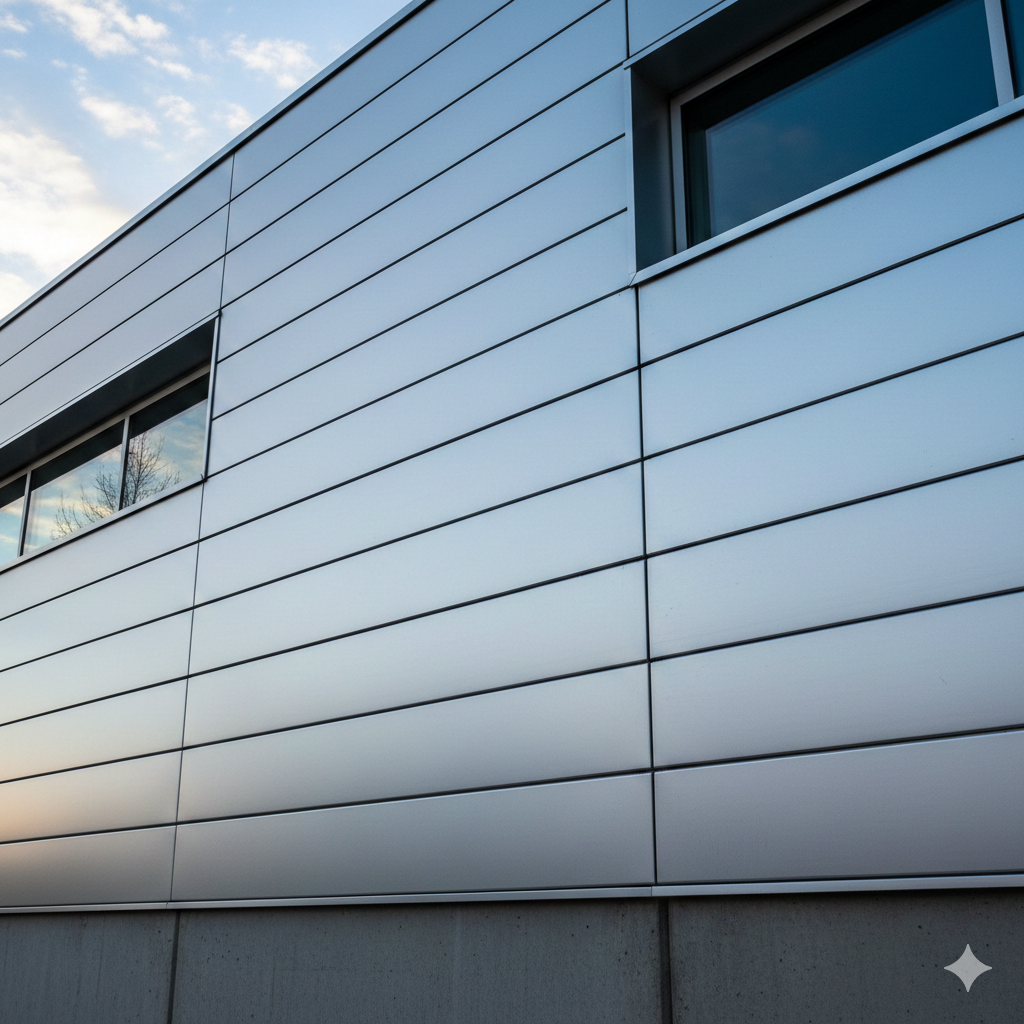
Metal composite panels used in architectural cladding are a specific subtype: thin metal skins bonded to a polymer core to create lightweight, rigid panels for facades. You should note that these sandwich panels behave differently from bulk metal-matrix composites in mechanical and thermal response.
Common Constituents and Composition
Matrix materials commonly include aluminum, magnesium, titanium, steel, and copper alloys because they balance ductility and conductivity with manufacturability. You will choose the matrix based on required stiffness, weight, thermal behavior, and corrosion resistance.
Reinforcements include ceramic particles (SiC, Al2O3), ceramic whiskers or fibers (continuous or short), and second-phase metals or intermetallics. Particle volume fraction typically ranges from a few percent to over 50%, depending on whether you prioritize toughness or stiffness.
Typical compositions:
- Aluminum-SiC: high stiffness and wear resistance for brake rotors and pistons.
- Titanium-fiber composites: high strength-to-weight for aerospace structural parts.
- Metal–polymer–metal sandwich panels: thin metal skins with polyethylene or mineral core for cladding and signage.
You should consider interface chemistry and thermal expansion mismatch when selecting constituents, as these control load transfer, fatigue life, and residual stresses.
Key Characteristics
Metal composite materials deliver tailored mechanical, thermal, and wear properties beyond monolithic metals. You can gain increased specific strength and stiffness, improved high-temperature stability, and enhanced wear or abrasion resistance by adjusting reinforcement type, size, and distribution.
Thermal conductivity can remain high in metal matrices while thermal expansion can be reduced with ceramic reinforcements, useful for electronic housings and heat sinks. Fatigue and fracture behavior depend strongly on interfacial bonding; good bonding improves load transfer but poor bonding can cause delamination or crack initiation.
Processing influences microstructure and performance: powder routes yield uniform particle dispersion, while casting and infiltration may produce directional fiber alignment. You should weigh manufacturing cost, achievable shapes, and recyclability when selecting a metal composite for your application.
Applications and Benefits
Metal composite materials combine metal matrices with reinforcements to deliver targeted improvements in strength, weight, wear resistance, and thermal performance. You can apply them where tailored mechanical properties and durability matter most, from building facades to high-performance engine components.
Architectural and Construction Uses
You can use metal composite panels for exterior cladding, curtain walls, and decorative facades where stiffness, flatness, and long-term weather resistance matter. Aluminum-faced metal composite panels offer low weight and dimensional stability, which reduces load on support structures and simplifies installation.
For structural elements, metal matrix composites (MMCs) reinforced with ceramic particulates or fibers provide higher stiffness and fatigue resistance than plain metals. You will find these in bridge components, structural brackets, and seismic retrofit elements where improved strength-to-weight ratio and reduced thermal expansion reduce maintenance needs.
Typical benefits for building projects:
- Reduced dead load and faster installation
- Improved resistance to corrosion and UV exposure
- Design flexibility: curved or perforated panels for aesthetic effects
Automotive and Aerospace Applications
You can replace heavier alloys with metal composites in chassis members, brake rotors, and transmission components to lower vehicle mass and improve fuel efficiency. MMCs reinforced with silicon carbide or alumina particles offer higher wear resistance for brake and clutch parts, extending service intervals.
In aerospace, you can use titanium- or aluminum-based composites in wing structures, engine mounts, and landing gear components that require high fatigue life and thermal stability. Composites also enable weight savings that directly increase payload capacity or range.
Key application examples:
- Automotive: lightweight body panels, heat-resistant brake rotors, engine pistons
- Aerospace: fuselage reinforcements, gearbox components, thermal shields
Performance Advantages
You gain measurable improvements in specific strength and stiffness when you select metal composites over monolithic metals. Reinforcements such as ceramic fibers raise tensile strength and modulus without proportionally increasing density, improving strength-to-weight ratio.
Wear and thermal stability improve markedly in tribological components. Particle- or fiber-reinforced MMCs resist abrasion and maintain dimensional tolerance at elevated temperatures, reducing component replacement and downtime. You also reduce thermal expansion mismatch in assemblies by choosing composites with tailored coefficients of thermal expansion.
Performance metrics to expect:
- Increased tensile strength and stiffness per unit mass
- Lower wear rates in sliding contacts
- Reduced thermal deformation and improved dimensional stability
Sustainability Considerations
You can lower lifecycle emissions by replacing heavier metals with lighter composites that improve vehicle fuel economy or aircraft range. Weight reduction often yields the largest operational energy savings, especially in transport applications.
Recyclability varies by system: metal matrices remain recyclable, but separating ceramic or polymer reinforcements can complicate recovery. You should evaluate end-of-life processing and prefer composites designed for disassembly or those using compatible, reclaimable materials.
Sustainability actions to take:
- Prioritize composites that enable operational energy savings
- Specify materials with documented recycling or reuse pathways
- Account for manufacturing energy and material sourcing in lifecycle assessments